Posts

Showing posts with the label agriculture

The Truth About Texas
Image
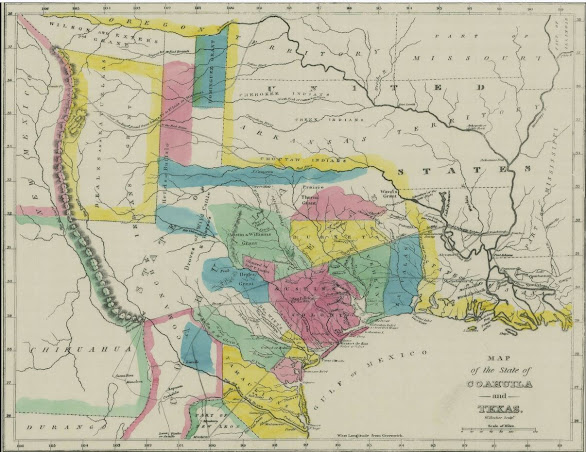
  Map of the State of Coahuila & Texas The Truth About Texas Davy Crokett circa 1834  after losing re-election to the US Congress "Y'all can go to Hell!  I'm going to Texas!"            Davy Crockett  on leaving his seat in the Tennessee legislature.  Spanish Mexico with vast stretches of thinly or completely uninhabited lands needed hardworking immigrants as much as the young USA. Spanish representatives touring the US to recruit settlers in 1820 met Moses Austin, in southeast Virginia.  Austin was agreeable and enthusiastic about moving to Mexico so Spain granted him a large stretch of land for him and his friends. Sadly, like Moses, this Moses never saw the promised land.  He died in June 1821 three months before Mexico declared independence in September of 1821.    His son, Stephen F. Austin, took over his father’s dream of a new settlement in Texas and soon received recognition of the Spanish...
Fiat Lux!

Image
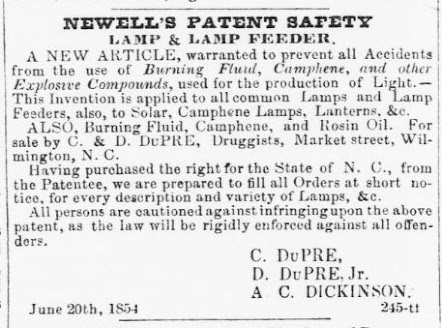
  Fiat Lux! Camphene & Burning Fluid for Sale There is darkness behind light. We take it for granted—lighting is cheap, easy, and quick. It was not always so. In a survey carried out by a newsmagazine in the late 1850s, people were asked to list the most important and useful things invented in the previous two decades.   At the top of the list: matches .  Matches made starting light so much easier and faster.   They were referred to at the time as "lucifers" from the devil angel's name which means in Latin "bringer of light."  Now, with lucifers, there was no more careful tending of a fire not to go out, or the difficult journey to a neighbor’s farm for a bit of fire to carefully take home.   Candles, lamps, and cigars could now be lighted anywhere. Matches were so cheap they were available to all levels of society. Originally made from phosphorus, matches could burst into flame with the slightest friction—in a pocket, scuffed on the floor, or simp...

1859 Largest Slave auction in History--Savannah, GA

Image
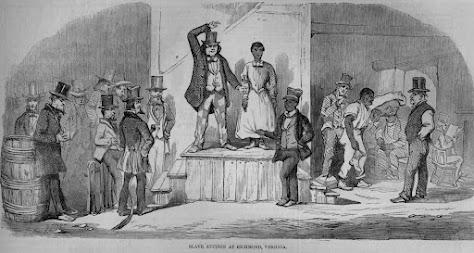
Slave Auction 1853-- Richmond, VA        By 1859 Pierce  Butler was no longer America's richest man.  At age 52, he had squandered the fortune inherited from his grandfather. Following the spectacle of his very public and very expensive divorce from English actress Fanny Kemble in 1849, gambling, and "bad investments," Butler declared bankruptcy in 1857.  His bankruptcy administrators  forced the immediate sale of his magnificent mansion in Philadelphia for $30,000.     It wasn't enough.      Now, all that was left to sell were the 436 human beings he held in slavery on two plantations in Georgia.      It would be the largest slave auction ever held in America.      Jonathan Bryan, a notorious slave dealer, was hired to run the auction. Bryan printed a catalogue of the "goods to be auctioned"  much as an auction house might publish a catalogue, listing paintings, jewelry or furniture to ...

On Managing Slaves December 1828

Image
  This photo of harvesting cotton was obviously taken long after 1828 but not a thing had changed         The following is courtesy of the South Carolina Historical Society An essay on slave management by the overseer of the Butler Plantations.  Contrast this description with Fanny Kemble's in 1838 several years after her husband, Pearce Butler took over. THE SOUTHERN AGRICULTURIST DECEMBER, 1828                                       PART I                 ORIGINAL CORRESPONDENCE ART. I -- On the Management of the BUTLER Estate, and the Cultivation of the Sugar Cane; by R. King, Jr. addressed to William Washington, Esq.                [COMMUNICATED FOR THE SOUTHERN AGRICULTURALIST.]                             ...

Old Times There Could Be Rotten--Plantation Life

Image
                     Cherry Hill Plantation, Inez, North Carolina Old Times There Could be Rotten Southern Plantation Life Part 1 of Several Entries on Slavery The modern stereotype of a Southern plantation as an enormous “Tara” like mansion surrounded by groves of magnolia and oak set in endless fields of cotton is only partly accurate.   Admittedly, this writer’s 3 times great grandparents on my mother’s side did live such a life.   But they were a minority among the elite planters of Warren County, North Carolina.             The 1860 census found Warrenton, county seat of Warren County, to be home to 2,600 souls, black and white, a number the population has yet to reach again.   In contrast to the present, it was the richest place in the state, not, as now, one of the poorest. Now a red tin roof, originally, this was a veranda with a railing where ladies w...