Posts

Showing posts with the label communication

The Post Office

Image
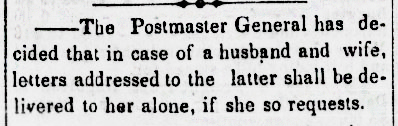
  December 21, 1859 Alexandria, Va. Gazette POST OFFICE In the modern age of email and internet we have little concept of how important safe, quick mail delivery was for the development of commerce.  The development of national brands of consumer items was not possible without quick reliable delivery.   A more subtle  impact the post office had on American infrastructure and commerce, was its ability to let contracts to carry the mail.  A mail delivery contract often made the difference in whether a railroad decided to extend a line to a particular area. Just as influential was the post office’s decision to let contracts to ships carrying mail to England, France, Mexico and other points.  Congress was reluctant to authorize money for the US Navy to buy or build steamships, (by the time the US Navy had three steamships, the British Navy had several hundred.)  When the Post office announced contracts to carry mail abroad, ship owners had to commissi...
1865-1866 The Trans Atlantic Telegraph Finally Successful

Image
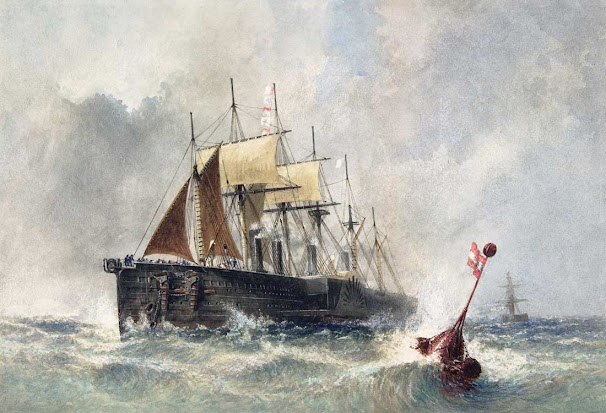
The Great Eastern Returning to a Buoy Marking a Break in the Cable (A painting by Robert Dudley)      Cyrus Field's powers of persuasion must have been enormous. After the spectacular and expensive failure of the 1858 cable he raised funds for another effort in 1865. Though he came from a reasonably prosperous middle class family, Field's rise was really "rags to riches" and his enemies never let him forget it calling him "a junk collector."  Though a wealthy man Field was officially a New York City licensed junk collector.  His paper mills supplemented  wood pulp paper  with cotton rags. He had rag collecting contracts much like a recycling company would have today with a steel mill. To keep warehouses full of rags, Field was officially licensed as a "junk collector."       Field kept up with telegraph technology.  Blame for the failure of the 1858 cable was tossed back and forth among several of the key players.  Th...

Moonshot--1857 The Trans Atlantic Telegraph

Image
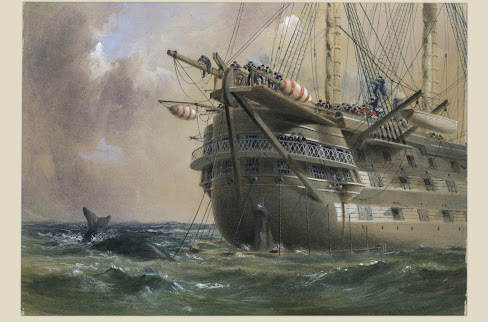
HMS Agamemnon laying the Trans Atlantic cable 1858 NASA's program to send a man to the moon required--and yielded-- a variety of scientific and technical breakthroughs.  The moonshot of the 1850s, laying a telegraph cable from the New World to the Old World require--and yielded-- significant technical and scientific discoveries.  It was expected that once ships and cable were ready and in place, it would take only six to eight days to connect the continents.  Instead, it took nearly ten years and six  $1,200,000  major failures. But it wasn't until the cables had been successfully connected and tested that the real trouble began. By 1852 Europe was  already laying lines short distances under water such as  across the Irish Sea and the English Channel. Early experiments in laying telegraph cable underwater demonstrated it took a lot more redesigning than simply putting more gutta percha and tar insulation around the copper wires and plunking it in the w...