Posts

Showing posts with the label slaves

The Truth About Texas
Image
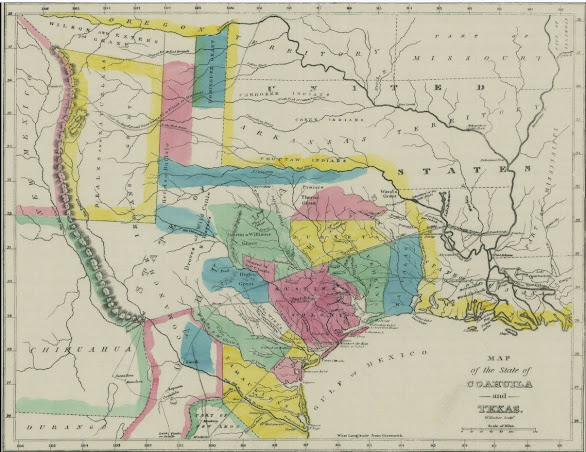
  Map of the State of Coahuila & Texas The Truth About Texas Davy Crokett circa 1834  after losing re-election to the US Congress "Y'all can go to Hell!  I'm going to Texas!"            Davy Crockett  on leaving his seat in the Tennessee legislature.  Spanish Mexico with vast stretches of thinly or completely uninhabited lands needed hardworking immigrants as much as the young USA. Spanish representatives touring the US to recruit settlers in 1820 met Moses Austin, in southeast Virginia.  Austin was agreeable and enthusiastic about moving to Mexico so Spain granted him a large stretch of land for him and his friends. Sadly, like Moses, this Moses never saw the promised land.  He died in June 1821 three months before Mexico declared independence in September of 1821.    His son, Stephen F. Austin, took over his father’s dream of a new settlement in Texas and soon received recognition of the Spanish...
1859 Largest Slave auction in History--Savannah, GA

Image
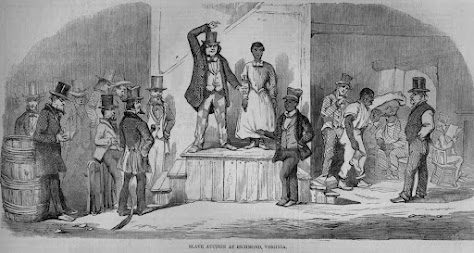
Slave Auction 1853-- Richmond, VA        By 1859 Pierce  Butler was no longer America's richest man.  At age 52, he had squandered the fortune inherited from his grandfather. Following the spectacle of his very public and very expensive divorce from English actress Fanny Kemble in 1849, gambling, and "bad investments," Butler declared bankruptcy in 1857.  His bankruptcy administrators  forced the immediate sale of his magnificent mansion in Philadelphia for $30,000.     It wasn't enough.      Now, all that was left to sell were the 436 human beings he held in slavery on two plantations in Georgia.      It would be the largest slave auction ever held in America.      Jonathan Bryan, a notorious slave dealer, was hired to run the auction. Bryan printed a catalogue of the "goods to be auctioned"  much as an auction house might publish a catalogue, listing paintings, jewelry or furniture to ...

On Managing Slaves December 1828

Image
  This photo of harvesting cotton was obviously taken long after 1828 but not a thing had changed         The following is courtesy of the South Carolina Historical Society An essay on slave management by the overseer of the Butler Plantations.  Contrast this description with Fanny Kemble's in 1838 several years after her husband, Pearce Butler took over. THE SOUTHERN AGRICULTURIST DECEMBER, 1828                                       PART I                 ORIGINAL CORRESPONDENCE ART. I -- On the Management of the BUTLER Estate, and the Cultivation of the Sugar Cane; by R. King, Jr. addressed to William Washington, Esq.                [COMMUNICATED FOR THE SOUTHERN AGRICULTURALIST.]                             ...

If America's Richest Man...

Image
(This is the first in a four part series)            If America's richest man married the most beautiful and talented actress in the English speaking world--and then she went to work in his warehouse or auto factory for four months and wrote a blistering report about conditions under which workers labored...      Well, that's happened before.      Pearce Mease Butler  had it all—and then some.  Handsome, well educated, charming, and very, very, very rich.   Pearce Mease Butler      His grandfather and namesake had been a British Officer who resigned his commission and settled in South Carolina in 1771 and soon built a fortune by the time of the Revolution.  Major Butler joined the Patriot cause.  An able soldier and distinguished politician, he was one of South Carolina’s representatives to the Continental Congress and a signer of the Declaration of Independence and later wrote ...

A New York Lady in SC 1859

Image
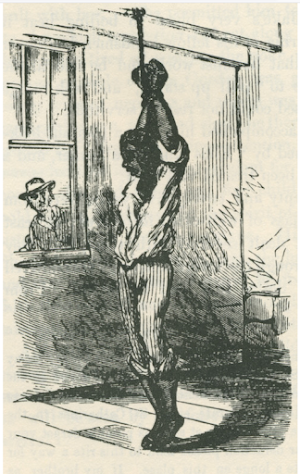
     A slave whipping   I am going to let the transcripts of several articles from the Edgefield, SC, Advertiser of March 23, 1859 speak for themselves. I have added a few notes in red to clarify terms or allusions to current events, modern readers would not understand. There is not much a decent or sane person can add otherwise, so I won't.       Edgefield SC—letter from a Northern lady of Oswego, NY   Re-Printed in the Edgefield, S.C. Advertiser, March 23, 1859   From the Oswego Times in New York State.   The following is an extract from a private   letter, by a New York lady to her brother. She is spending the winter with an invalid daughter in South Carolina:   AIKEN, S. C., Feb. 2d, 1859.        My DEAR BROTHER:-We are in what is called the Pine Woods District, 120 miles   west of Charleston. Aiken is a small town of not more than 1000 inhabitants, and the dullest pl...

Slavery In the North

Image
  In the North, freedom from slavery was traded for no rights as free men.     The Abolitionists movement did not start to spread until the 1830s. All through the Civil War, Abolitionists were viewed as a loud and often extreme minority.  While Abolitionists fought to free the enslaved, most still thought blacks were an inferior race and should not have all the privileges of whites.  A good modern analogy might be PETA -People for Ethical Treatment of Animals—movement. Most people agree in general animals should not be treated cruelly, but few people even in PETA believe goats, snails, chimpanzees or gorillas should be given the right to vote or testify in court.  Negroes in Indiana September 12, 1858 Rising Sun Visitor newspaper              In the Floyd Circuit Court, recently, the Judge decided the law forbidding the introduction of Negroes in this State unconstitutional. The Judge of the Circuit is ...